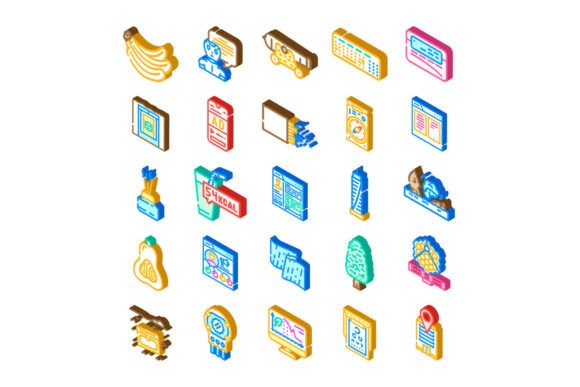
Isometric Digital and Physical Objects I: Bridging Visual Communication Across Mediums
Isometric Digital and Physical Objects I is a visual design approach that merges digital and tangible elements using isometric projection—a technique that represents 3D objects in 2D space without perspective distortion. This style has gained popularity for its ability to illustrate complex concepts such as advertising strategies, data analysis workflows, nutrition planning, communication systems, and web development structures in a clear, engaging format. Unlike flat design or realistic 3D renderings, Isometric Digital and Physical Objects I balances stylization with clarity, making it a versatile choice for both digital interfaces and printed materials.
What Makes Isometric Digital and Physical Objects I Unique?
At its core, Isometric Digital and Physical Objects I leverages a 30-degree angle projection to create the illusion of depth without the complexity of full 3D modeling. This allows designers to depict both digital and real-world objects—such as smartphones, laptops, food items, or data charts—in a consistent visual language. The result is a cohesive and scalable visual system that supports a wide range of applications, from infographics and dashboards to product packaging and educational materials.
One of the defining characteristics of this style is its adaptability. Whether used in a mobile app interface or a printed nutrition guide, Isometric Digital and Physical Objects I maintains visual harmony while preserving the recognizability of each object. This makes it especially effective for explaining abstract or technical concepts in a way that feels intuitive and grounded.
Comparing Isometric Digital and Physical Objects I with Other Visual Styles
When compared to flat design, Isometric Digital and Physical Objects I offers more dimensionality, which can enhance user engagement without overwhelming the viewer. Flat design, while clean and modern, often lacks the depth needed to illustrate spatial relationships or layered systems. On the other hand, full 3D renderings can be visually rich but are typically more resource-intensive and harder to integrate across different platforms.
Isometric Digital and Physical Objects I also differs from skeuomorphic design, which mimics real-world textures and materials in digital interfaces. While skeuomorphism creates familiarity, it can feel outdated or overly literal. Isometric design, by contrast, strikes a balance—offering visual depth and realism without being bound by physical constraints.
Strengths and Use Cases
One of the primary strengths of Isometric Digital and Physical Objects I lies in its ability to simplify complex systems. For example, in data analysis, isometric visuals can illustrate how data flows through different stages—from collection and processing to visualization and decision-making—without the clutter of traditional flowcharts. Similarly, in web development, isometric icons can depict the interaction between front-end and back-end components, helping both developers and stakeholders visualize the architecture.
- Advertising: Isometric visuals can present product features in a compact, engaging layout that works well in digital banners and social media posts.
- Nutrition: Meal plans and dietary guidelines become more digestible when illustrated with isometric food icons and portion guides.
- Communication: Messaging platforms and collaboration tools use isometric illustrations to guide users through interface features and workflows.
Tradeoffs and Limitations
Despite its advantages, Isometric Digital and Physical Objects I is not universally applicable. One limitation is the learning curve associated with creating or modifying isometric illustrations. Designers need to maintain consistent angles and proportions, which can be time-consuming. Additionally, while the style supports clarity, overuse or poor implementation can lead to visual fatigue, especially in interfaces with dense content.
Another consideration is scalability. While isometric visuals work well for small-scale illustrations and icons, they may become unwieldy in large, complex diagrams. In such cases, alternative visual frameworks—such as wireframes, flowcharts, or layered diagrams—may offer better clarity and flexibility.
When Isometric Digital and Physical Objects I Is the Right Choice
This style excels in scenarios where visual storytelling and conceptual clarity are key. It’s particularly effective in educational content, marketing materials, and UI/UX design where the goal is to engage users without overwhelming them. For instance, a SaaS company explaining its analytics dashboard might use Isometric Digital and Physical Objects I to show how data moves from source to visualization in a way that’s both informative and visually appealing.
Similarly, health and wellness brands can use isometric illustrations to break down complex nutritional information into digestible visuals. By representing food items and dietary metrics in a consistent visual format, these brands can improve user comprehension and engagement.
When Another Style Might Be Better
If the goal is to convey realism or photorealistic detail, other styles such as 3D rendering or augmented reality visualization may be more appropriate. Likewise, in highly technical fields like engineering or architecture, where precise measurements and spatial accuracy are critical, Isometric Digital and Physical Objects I may not provide the necessary level of detail.
For interfaces that prioritize minimalism or require rapid prototyping, flat design or wireframing tools may offer a more streamlined approach. These alternatives can reduce development time and simplify the design process, especially in agile environments where speed and flexibility are essential.
Practical Comparisons and Real-World Examples
Consider a project management tool that uses Isometric Digital and Physical Objects I to explain task workflows. The isometric visuals might show a digital calendar, a team collaboration board, and a progress tracker all interacting within a single visual. This helps users understand how different features work together without requiring a textual explanation.
In contrast, a financial dashboard that needs to display real-time stock data may rely more on charts and graphs rather than isometric visuals. The priority here is data accuracy and speed of interpretation, where flat or line charts may be more effective than stylized illustrations.
Another example is in e-commerce. A nutrition supplement brand might use isometric illustrations to show how a product fits into a daily routine—showing a bottle of vitamins next to a coffee cup, a smartphone tracking app, and a gym bag. This contextual storytelling can be more compelling than a standard product photo.
Decision Factors to Consider
When evaluating whether to use Isometric Digital and Physical Objects I, consider the following factors:
- Target audience: Are users more likely to respond to stylized visuals or realistic imagery?
- Content complexity: Does the material benefit from simplified, conceptual visuals or require detailed, precise representations?
- Design resources: Is the team equipped to create and maintain isometric illustrations, or would a simpler style be more efficient?
- Brand identity: Does the existing visual language align with the clean, structured look of isometric design?
Conclusion
Isometric Digital and Physical Objects I offers a compelling middle ground between flat design and full 3D visualization. Its strength lies in its ability to convey depth and context without sacrificing clarity or scalability. While it may not be the best fit for every project, it provides a valuable tool for designers looking to enhance communication through visual storytelling. By understanding its strengths, limitations, and ideal use cases, professionals can make informed decisions about when and how to incorporate this style into their work.